
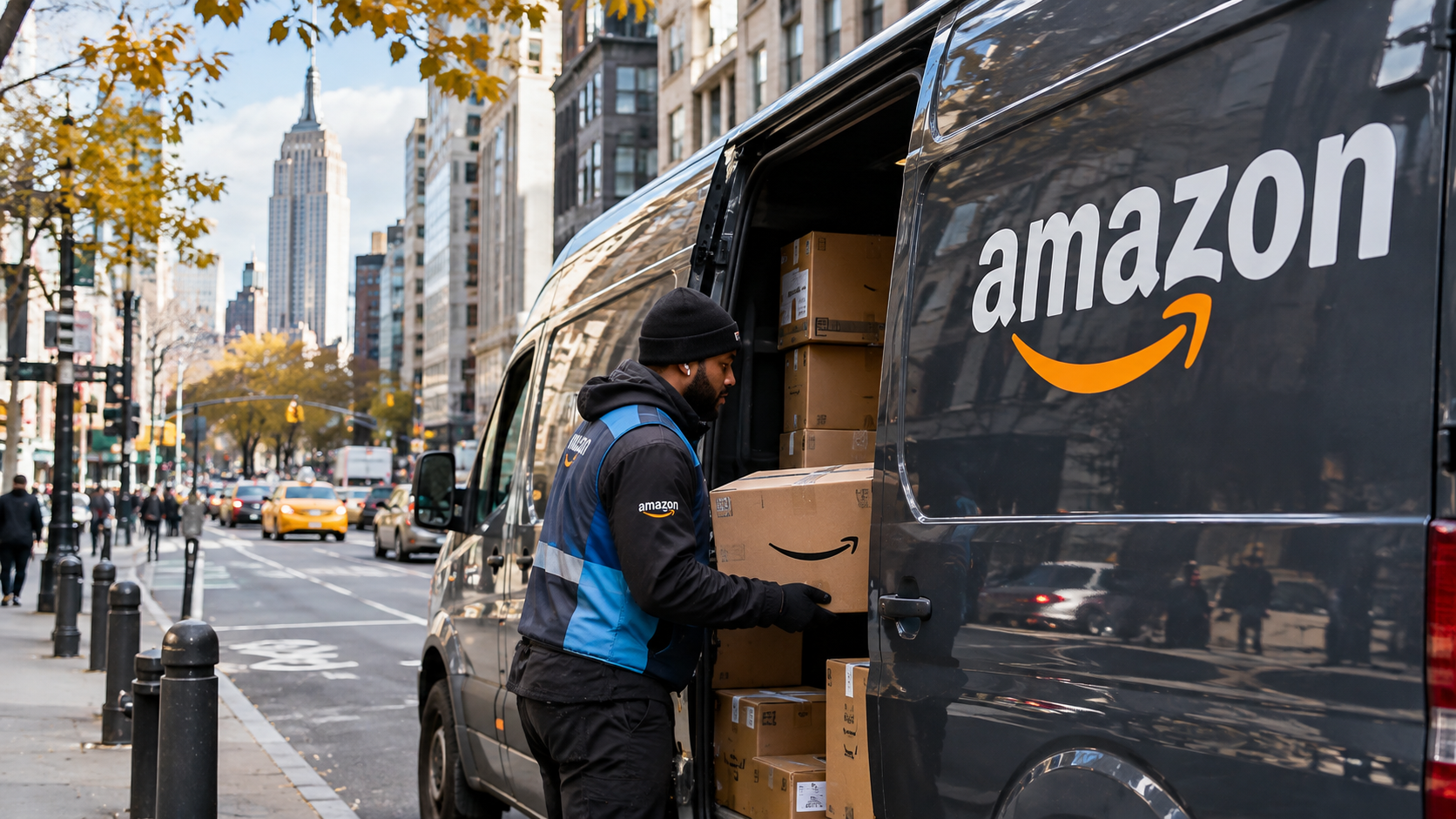
NEW YORK — November 20, 2026 — Amazon is taking its opposition to proposed New York City delivery regulations directly to customers, warning shoppers that orders could cost as much as $5 more if legislation aimed at restructuring last-mile delivery operations becomes law.
The company began displaying messages on its website and shopping app November 19 urging customers to oppose the Delivery Protection Act, also known as Intro 518. Amazon says the proposal could force changes to its delivery network, threaten small delivery businesses and ultimately increase costs for consumers.
The $5 figure is Amazon's estimate of a potential cost increase. No such fee has been enacted or announced as an actual customer surcharge, and the legislation does not establish a $5 charge on orders.
The proposed law, however, goes well beyond delivery fees. It would fundamentally change how companies operating last-mile delivery facilities employ the people who sort, handle and deliver packages.
What the legislation would change
Intro 518 would require covered last-mile delivery facilities to obtain a city license and comply with new employment, training, safety and operational requirements. The proposal would place the facilities under the oversight of New York City's Department of Consumer and Worker Protection.
Among its most significant provisions is a requirement that operators directly employ workers performing core warehouse and delivery services. The bill would generally prohibit operators from subcontracting those functions to third-party companies, including staffing agencies.
That provision strikes directly at the delivery model used by Amazon, which relies heavily on its Delivery Service Partner (DSP) program. Under the DSP model, independent businesses contract with Amazon to deliver packages. Those businesses hire drivers, handle payroll and employment matters, and manage their own workforces, while operating within Amazon's delivery network and service requirements.
Intro 518 would generally require the facility operator to take on the employment relationship for workers performing covered warehouse and delivery functions instead of relying on those third-party businesses.
The bill also includes worker-retention provisions addressing employees displaced when subcontracting arrangements are terminated, safety and training requirements, recordkeeping obligations and enforcement provisions that could affect a facility's ability to maintain its license.
The legislation would carry significant implications for delivery contractors whose businesses depend on providing drivers and services to larger companies.
Amazon warns of job losses and higher costs
Amazon has argued that the legislation could undermine the independent businesses operating within its delivery network and force the company to reconsider its New York City operations. The company says its DSP program provides opportunities for entrepreneurs to build delivery businesses while creating thousands of jobs. Amazon has warned that eliminating its ability to contract with those businesses could result in operations moving outside the city, potentially affecting delivery times, employment and costs.
Amazon's customer-facing campaign is designed to bring that argument directly to shoppers, asking them to contact elected officials before the legislation advances. The company has also urged City Council members to visit its facilities and meet with delivery business owners and workers to better understand how its current delivery network operates.
Whether the proposed legislation would result in a $5 increase per order remains unsubstantiated publicly. Amazon has not released a detailed calculation showing how the estimate was reached or how much of any potential increase would be attributable to employment costs, operational changes, facility relocation or other factors.
Worker protections versus the contractor model
Supporters of the Delivery Protection Act argue that companies controlling delivery networks should be accountable for the conditions under which their packages are handled and delivered. Labor advocates contend that subcontracting can create layers between the company controlling the operation and the workers performing the job, complicating accountability for workplace conditions, training, safety and employment practices.
The proposal seeks to address those concerns by placing employment responsibility more directly with facility operators rather than allowing core delivery and warehouse functions to be performed through third-party contractors.
Opponents, including businesses operating within contractor-based delivery networks, argue that eliminating those arrangements could threaten independently owned companies, displace workers and increase operating costs without necessarily guaranteeing better outcomes.
The debate has put the City Council in the middle of a broader conflict over how last-mile delivery should be structured, who should be responsible for its workforce and whether the contractor model can continue under tighter regulation.
Legislation remains under consideration
Intro 518 was introduced in February and received a hearing before the City Council's Committee on Consumer and Worker Protection in April. It was subsequently laid over in committee and has not been enacted. The proposal continues to face debate over its employment provisions, impact on businesses and potential consequences for the city's delivery network. Changes to the bill remain possible as lawmakers, labor representatives, business interests and Amazon continue to weigh in.
For New York City shoppers, there is no $5 Delivery Protection Act charge at this time.
For the delivery industry, however, the debate could have consequences well beyond the price of an online order. If the direct-employment provisions survive and become law, New York City could force one of the country's largest last-mile delivery networks to reconsider the role third-party contractors play in getting packages from warehouse doors to customers' doorsteps.
The question is no longer simply what delivery costs. It is who will employ the workers, who will carry the responsibility for the operation, and whether the contractor-based last-mile model can survive the changes being proposed.