
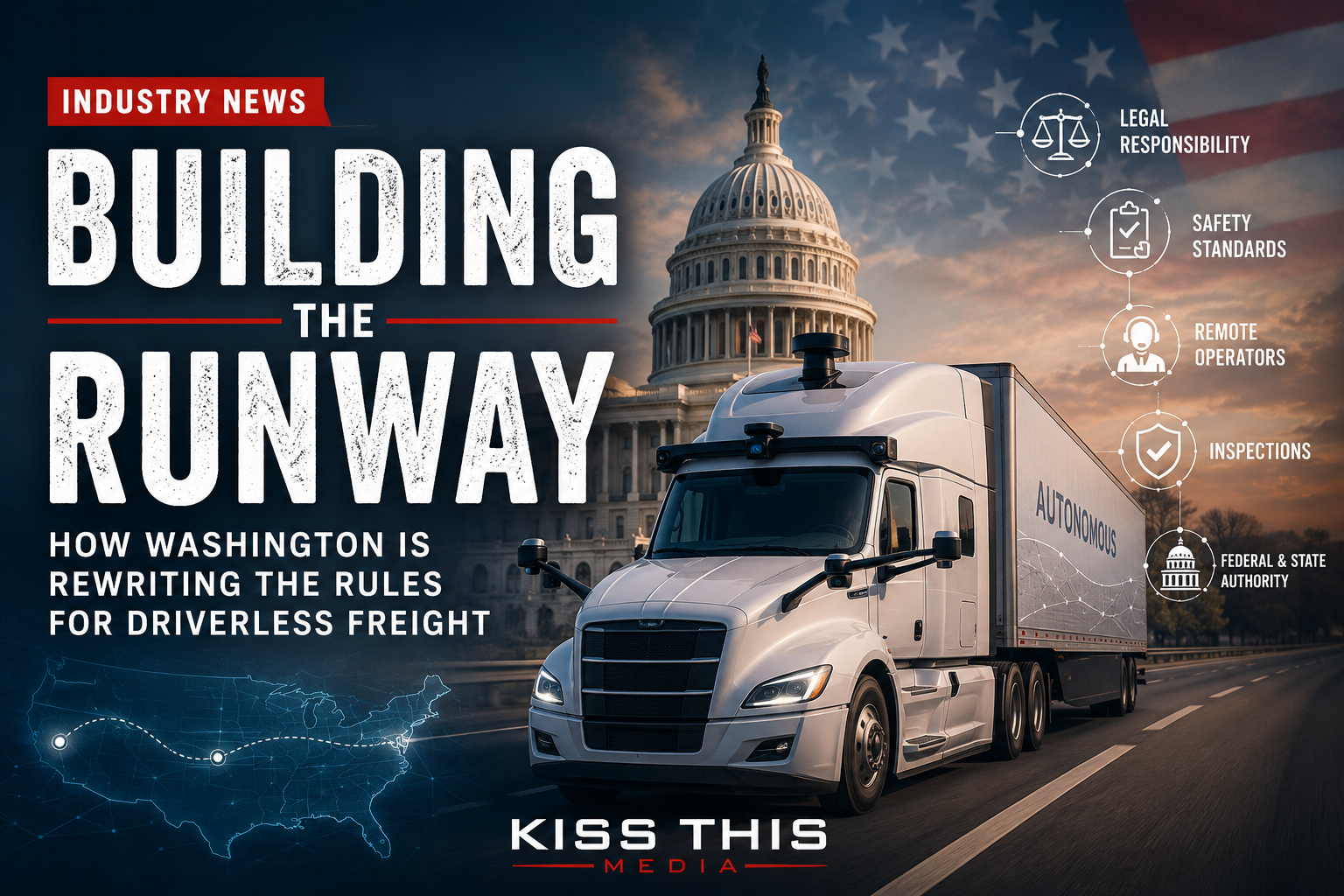
WASHINGTON — In recent months, federal agencies, lawmakers, and autonomous trucking companies have each announced developments that, viewed independently, appear to be routine policy updates or industry milestones. Taken together, however, they suggest the United States is laying the regulatory foundation for the future deployment of autonomous commercial trucks.
The latest example came as the U.S. Department of Transportation, through the National Highway Traffic Safety Administration (NHTSA), moved to modernize portions of the Federal Motor Vehicle Safety Standards (FMVSS). Many of those standards were written decades ago with one basic assumption: every commercial vehicle has a human driver behind the wheel.
Among the new proposed changes are regulations involving windshield wiping and defrosting systems, transmission shift position displays, brake pedals, and other equipment designed for a human operator. At first glance, it may seem unusual that federal regulators are discussing windshield wipers or brake pedals. The question, however, isn't whether autonomous trucks should have brakes or meet federal safety standards — they still would. The question is whether a vehicle designed to operate exclusively with an Automated Driving System (ADS) should be required to have equipment intended solely for a human driver.
For example, if an autonomous truck relies on cameras, radar, and other sensors rather than a driver's vision, does a truck really need windshield wipers if there is no driver in the seat? The proposed rule changes do not authorize widespread deployment of driverless trucks. Instead, they begin the process of updating regulations written for conventional vehicles to determine which standards still apply, which should be modified, and which new standards may be needed as autonomous technology advances.
At the same time, Congress is considering legislation that would establish a national framework for autonomous vehicles. Among the proposals is H.R. 7390, the SELF DRIVE Act of 2026, which addresses testing, safety oversight, exemptions, data reporting, and federal oversight of automated driving systems. Rather than leaving manufacturers to navigate different regulatory approaches from state to state, the bill seeks to establish a more consistent federal framework for the development and deployment of autonomous vehicle technology.
Separately, autonomous trucking provisions included in the proposed BUILD America 250 transportation legislation move beyond passenger vehicles and focus specifically on commercial freight. Those provisions direct federal agencies to begin developing standards addressing how autonomous commercial motor vehicles would be inspected, how remote operators and dispatch personnel would be regulated, what responsibilities carriers would have, and how existing commercial motor vehicle regulations should apply when there is no driver behind the wheel.
The Federal Motor Carrier Safety Administration has also taken steps that recognize the growing presence of autonomous technology. Earlier this year, the agency granted a temporary waiver allowing autonomous commercial trucks operated by Aurora to use cab-mounted warning beacons in place of traditional roadside warning devices under specific circumstances. That waiver may appear minor, but it illustrates the practical challenges regulators are beginning to encounter.
Existing FMCSA regulations require a driver who stops on the roadside under certain conditions to exit the truck and place reflective warning triangles behind the vehicle. A driverless truck cannot perform that task. The waiver allows regulators to evaluate an alternative safety measure while broader questions about how existing regulations should apply to autonomous commercial vehicles continue to be addressed.
Meanwhile, the private sector continues to expand. Autonomous trucking companies have increased driverless freight routes, opened new transfer hubs, and announced partnerships with carriers and shippers as they prepare for broader commercial deployment. Companies are also investing in remote operations centers, mapping technology, cybersecurity, artificial intelligence, fleet monitoring systems, and other infrastructure designed to support autonomous freight operations.
For transportation observers, the individual announcements are familiar. Vehicle exemptions. Pilot expansions. Proposed legislation. Agency guidance. The broader pattern has received far less attention. Large-scale deployment of autonomous freight will require significantly more than trucks capable of driving themselves.
It will also require regulators to determine how roadside inspections should be conducted, how crashes involving autonomous commercial vehicles should be investigated, who is legally responsible when there is no driver in the cab, how remote operators should be regulated, how first responders and law enforcement interact with autonomous vehicles, what cybersecurity standards should apply, and how insurance and liability frameworks should evolve alongside the technology.
Many of those discussions are now occurring simultaneously across multiple federal agencies and congressional committees. States have also entered the debate. While federal policymakers work toward national standards, several state legislatures have introduced measures that would either facilitate or restrict autonomous commercial vehicle operations.
Missouri lawmakers are considering legislation that would allow autonomous commercial vehicles while limiting the ability of local governments to prohibit them. California has adopted regulations allowing the testing and future deployment of heavy-duty autonomous vehicles under defined conditions. Florida lawmakers have proposed requiring a licensed human operator to remain inside certain autonomous commercial vehicles transporting freight or passengers. Alabama has considered requiring a human driver aboard autonomous trucks hauling oversized or overweight permitted loads. Kentucky lawmakers continue debating how heavier autonomous commercial vehicles should be regulated on public highways.
Those proposals reflect different philosophies. Some states are preparing for autonomous commercial freight by establishing regulatory pathways. Others are seeking to preserve a role for human drivers or impose additional safeguards before autonomous technology is permitted to expand. The result is an emerging conflict between interstate freight regulations and the authority traditionally exercised by individual states over roadway safety.
Industry groups argue that a consistent national framework is necessary for autonomous freight to operate efficiently across state lines. Labor organizations and some safety advocates have raised concerns about workforce impacts, emergency response procedures, public safety, and whether existing regulations adequately address the unique challenges presented by vehicles operating without a driver in the cab.
None of the current federal proposals, standing alone, guarantees widespread deployment of driverless commercial trucks. Combined together, they illustrate that policymakers are increasingly addressing questions that extend well beyond the technology itself. The debate over whether autonomous trucks exist is over. Lawmakers and regulators are now working on creating the framework for how they will operate within our nation's transportation system.
The conversation is no longer centered on whether autonomous trucks can exist. The work now underway is focused on how they will operate. The industry has moved beyond "can we?" and "what if?" to "how do we regulate what is already being built?"